
In Hokkien, a character’s tone can change depending on where it appears.
The basic rule is simple:
If a character is last, it keeps its original tone. If another character comes right after it, the tone changes.
Just remember these three terms:
Citation tone = the original tone, like how the word is read by itself.
Sandhi tone = the changed tone when another character follows.
Neutral tone = a light tone with no tone mark.
This guide uses Tangliengim (TLI) to explain how these mechanisms work. It shows both the Taipei and the Singapore tone sandhi pattern: use the Sandhi setting in the language menu at the top right to switch. The examples sound the same in both.
- Tone legend
- Sandhi pattern
i. Character type & punctuation
ii. Neutral tone
iii. Verbs ending in noun characters
iv. Sandhi in noun-characters
v. Verb-noun-verb constructions
1. Tone legend
Hokkien is represented with five tones in the TLI system. The five tone marks used here are:
| Tone Name | Tone Mark | Remarks | |
| 1 | High | ˆ | 덩 (東) (≈ Pinyin’s 1st tone) ¹ |
| 2 | Falling | ˋ | 덩 (黨) (≈ Pinyin’s 4th tone) ² |
| 3 | Low | (unmarked) | 덩 (棟) (≈ Pinyin’s 3rd tone) ³ |
| 4 | Rising | ˊ | 덩 (同) (≈ Pinyin’s 2nd tone) ⁴ |
| 5 | Mid | ˉ | 덩 (洞) ⁵ |
¹ IPA 44 ˦ & 4 ˦; POJ Tone 1 and Tone 8 (merged in TLI notation)
² IPA 53 ˥˧; POJ Tone 2
³ IPA 21 ˨˩ & 32 ˧˨; POJ Tone 3 and Tone 4 (merged in TLI notation)
⁴ IPA 214 ˨˩˦; POJ Tone 5
⁵ IPA 22 ˨; POJ Tone 7
2. Sandhi pattern
When a tone changes, it follows the pattern below. The examples given in this article will also show how the pattern works in practice. Read each arrow as ‘becomes’: for example, High becomes Mid.
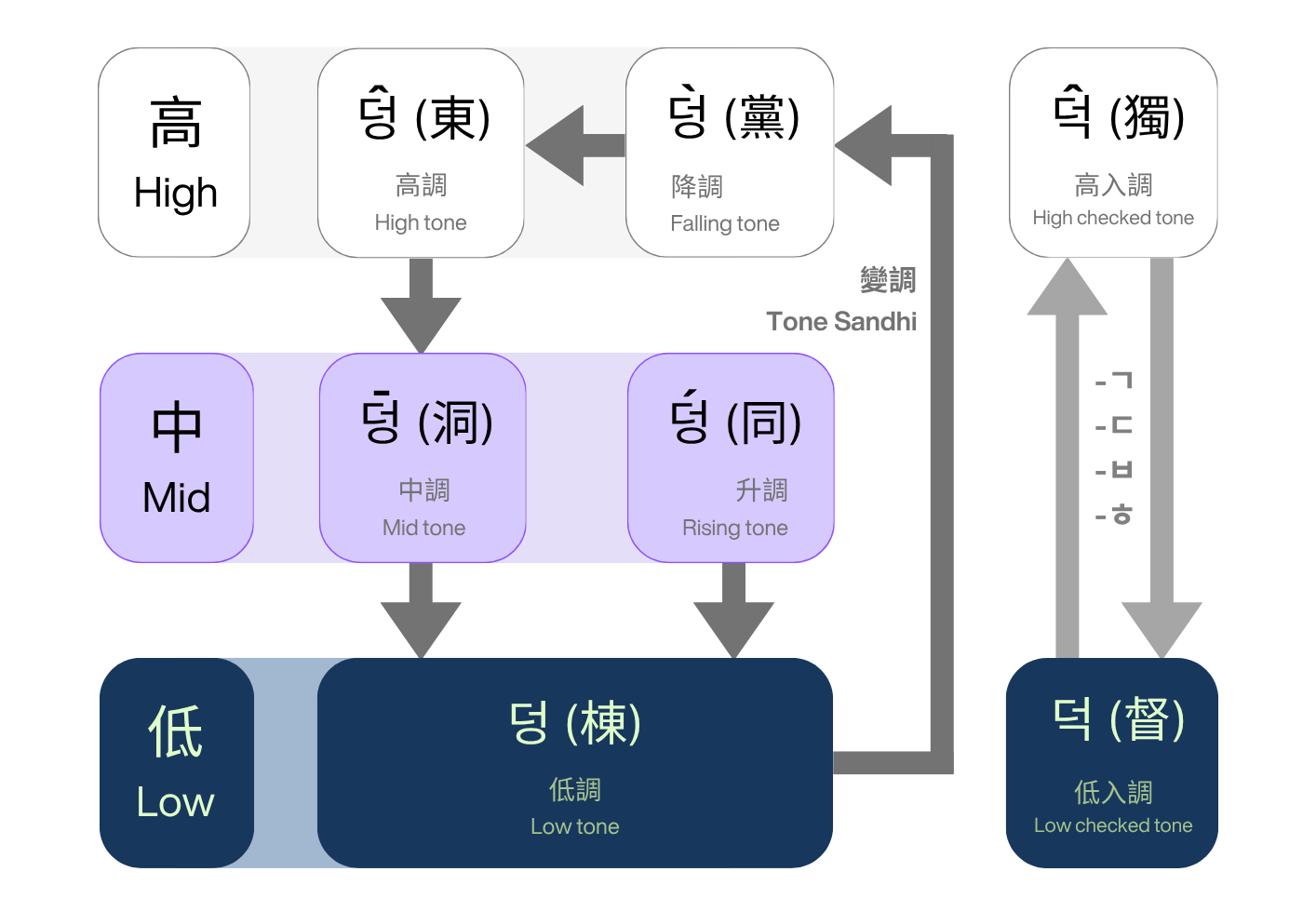
Text version of the diagram
| Tone (example) | Before another syllable |
|---|---|
| High (東) | Mid |
| Mid (洞) | Low |
| Rising (同) | Low |
| Low (棟) | Falling |
| Falling (黨) | High |
| High checked (獨) | Low checked |
| Low checked (督) | High checked |
Checked syllables end in -ㄱ, -ㄷ, -ㅂ or -ㅎ.
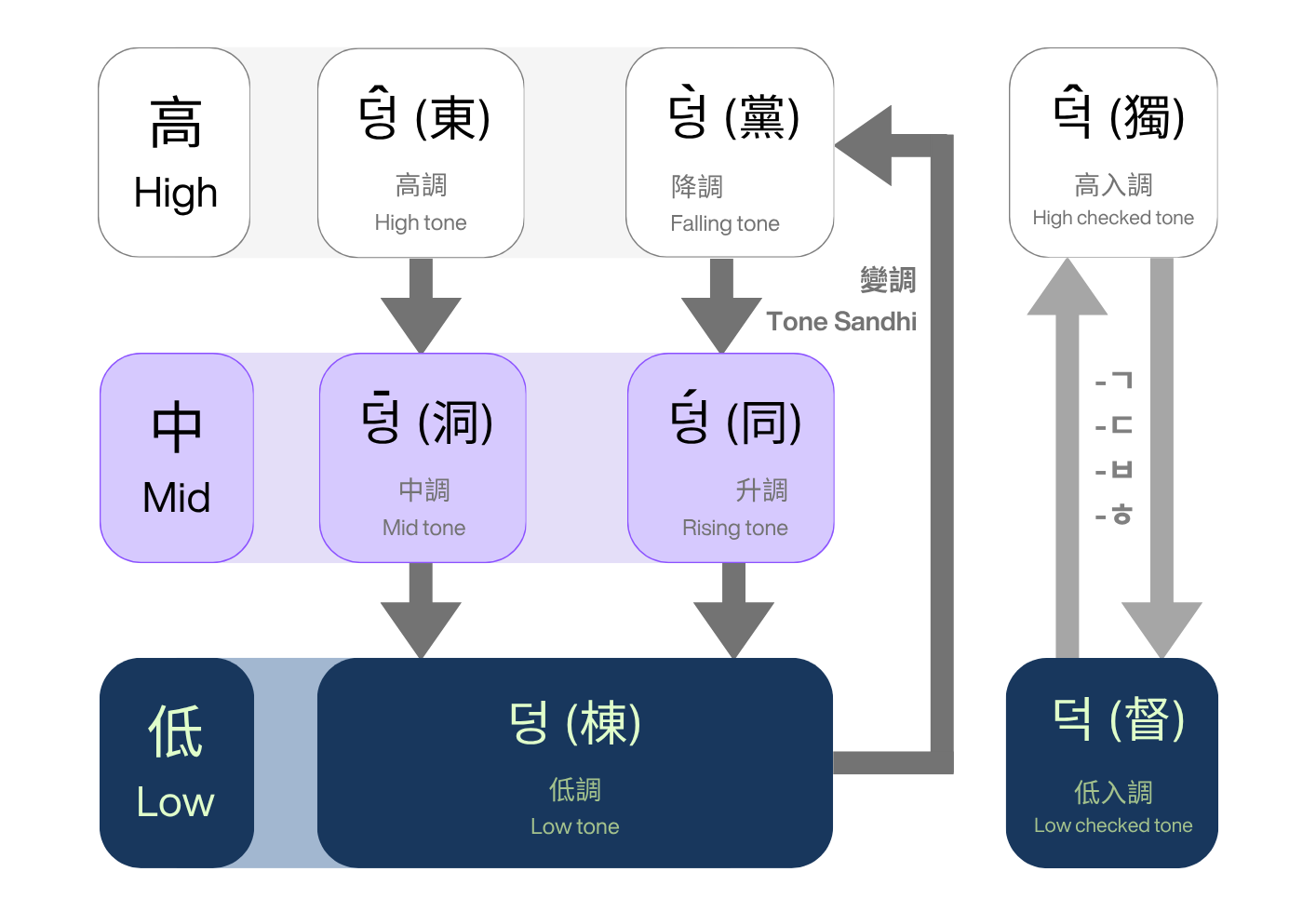
Text version of the diagram
| Tone (example) | Before another syllable |
|---|---|
| High (東) | Mid |
| Mid (洞) | Low |
| Rising (同) | Low |
| Low (棟) | Falling |
| Falling (黨) | Rising |
| High checked (獨) | Low checked |
| Low checked (督) | High checked |
Checked syllables end in -ㄱ, -ㄷ, -ㅂ or -ㅎ.
i. Character type & punctuation
Some characters behave like nouns. These are noun-characters (N). They often prefer to keep their original tone, even when another character follows.
Everything else is marked as X. These are usually verbs, adjectives, prepositions, and other non-noun-characters. When another character follows, they usually change tone.
Spaces and punctuation are not just decoration. They tell you where a phrase ends. The character right before a space, comma, period, or ’ keeps its original tone.
In the examples, N marks a noun-character (one that behaves like a noun) and X marks everything else.
Examples:
릐 is citation with a space before it. 킈 is citation because it is final.
꽈 is citation with a space behind it. 킈 is sandhi (킈 → 킈) because 쿤 comes directly after it. 쿤 is citation because it is final.
랑 is citation with a space behind it. 쟣 undergoes checked-tone sandhi, the sandhi of a syllable ending in -p, -t, -k or -h (쟣 → 쟣) with 븡 directly attached after it. 븡 is citation because it is final.
Here are some common words listed for reference:
| Noun-characters N | |||
|---|---|---|---|
| POS | English | Hokkien | Audio |
| Noun | kue (kueh/kuih) | 粿kuè | |
| Noun | person | 人láng | |
| Noun | noodles | 麵mī | |
| Noun | rice / meal | 飯pn̄g | |
| Noun | water | 水jùi | |
| Noun | book | 冊cheh | |
| Pronoun | I / me | 꽈goà | |
| Pronoun | you | 릐lì | |
| Pronoun | he / she / it | 이ī | |
| Non-noun-characters X | |||
|---|---|---|---|
| POS | English | Hokkien | Audio |
| Verb | speak / say | 講kòng | |
| Verb | come | 來lái | |
| Verb | drink | 飲lîm | |
| Verb | eat | 食jiâh | |
| Verb | go | 去khi | |
| Verb | listen / hear | 聽thiâ̰ | |
| Adjective | big | 大toā | |
| Adjective | red | 紅áng | |
| Preposition | object-fronting / causative marker | 가-ka-* | |
| Preposition | at / in | 듸-ti- | |
| * 가- (ka-) was originally the character “共”, now used as a grammar word. | |||
ii. Neutral tone
Neutral tone, simply put, is a tone in which a character is deemphasised and pronounced quickly at a low pitch.
a. Particles
Particle words that come after ’ like ’에 (’e), ’롷킈 (’loh-khi) and ’짇에 (’jit-e) lose their tone marks and become neutral. Exception: ’ᄅᆤ (liàu) keeps its Falling Tone/Tone 2.
After a ’ phrase, put a space or punctuation before the next normal word. This shows that the neutral part has ended. You can also stack several neutral particles after the same ’.
Examples:
에 became neutral (에 → 에) because it comes after ’. 먀 is citation because it starts a new phrase after the space (and is the last character).
Everything after ’ is neutral until the spacing. 쥐 is citation because the space before it starts a new normal word (and is the last character).
The character before ’ is treated like it is phrase-final. So it keeps its original tone.
Note for mixed-script writing: write particles after ’ in Hangul, not Hanri (漢字; Chinese characters). This makes the neutral-tone part easy to see.
b. Pronouns
Pronouns can also become neutral when they are the object of the verb (the one the action is done to), appearing after ’.
Example:
릐) is neutral because it comes after ’. It loses its tone mark.
iii. Verbs ending in noun-characters
Some verbs, such as 재얄 (jāi-yà̰, “to know”) and 탁쳏 (thak-cheh, “to study“), end in a noun-character, so their final character does not undergo tone sandhi in a sentence. Tone behaviour is still determined character by character.
Example:
Since 재얄 is formed by combining non-noun-character 재 and noun-character 얄, 재 underwent tone sandhi (재 → 재) while 얄 does not.
iv. Sandhi in noun-characters
Noun-characters usually resist tone change, but they are not immune. If an N character is glued tightly into a larger word, name, or fixed expression, it can change tone too.
Example:
In 진덩, 진 changes tone (진 → 진) because it is glued to 덩 as one phrase.
If a postposition (a word attached after a noun, such as –래 ‘in’) is attached to a noun character, the noun character undergoes tone sandhi.
Example:
심 is a noun-character, but undergoes tone sandhi (심 → 심) due to the attached postposition –래 (meaning ‘in’).
v. Verb-noun-verb constructions
Sometimes a noun-character gets trapped inside a verb phrase. When that happens, it can change tone too.
Example:
턀랑겅 literally means ‘hear people say,’ but together it acts like ‘hearsay.’ Because 랑 is stuck inside the phrase, it changes tone (랑 → 랑).